April 23, 2011

How To Steal Like An Artist (and 9 Other Things Nobody Told Me)


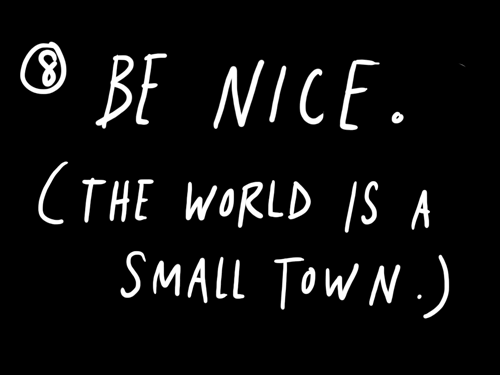
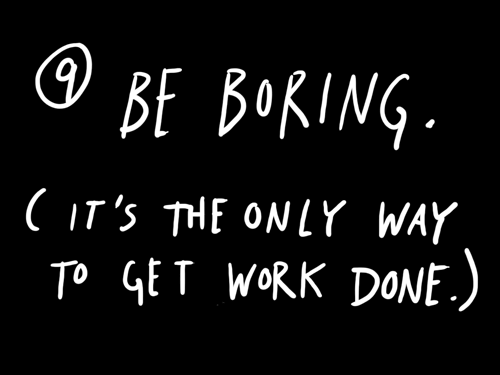
Great advice, inspiration and reminders via Austin Kleon. Full details on each point are here


Every artist gets asked the question, "Where do you get your ideas?"
The honest artist answers, "I steal them."


If I waited to know "who I was" or "what I was about" before I started "being creative," well, I'd still be sitting around trying to figure myself out instead of making things. In my experience, it's in the act of making things that we figure out who we are.   
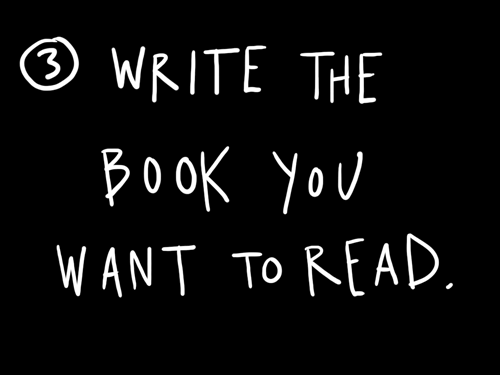

The best way to find the work you should be doing is to think about the work you want to see done that isn't being done, and then go do it. Draw the art you want to see, make the music you want to hear, write the books you want to read.


Art that only comes from the head isn't any good. Watch any good musician and you'll see what I mean... So my advice is to find a way to bring your body into your work. Draw on the walls. Stand up when you're working. Spread things around the table. 
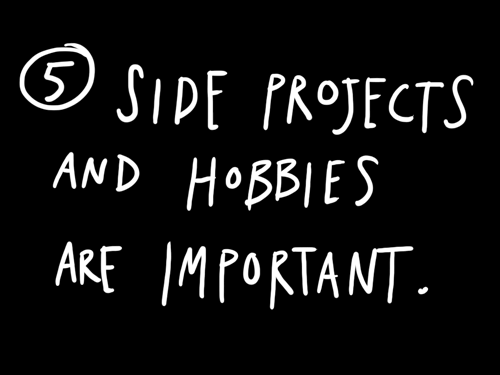

By side projects, I mean the stuff that you thought was just messing around. Stuff that's just play. That's actually the good stuff. That's when the magic happens. 
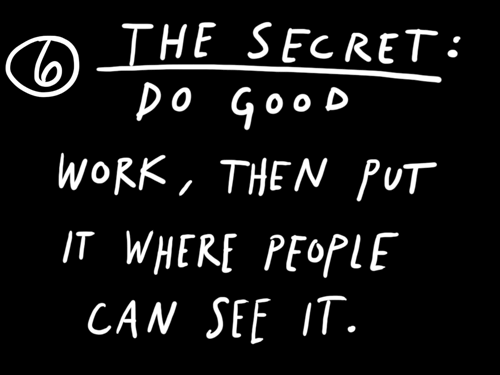

One of the things I've learned as an artist is that the more open you are about sharing your passions, the more people love your art. 


"Be regular and orderly in your life, so that you may be violent and original in your work." [Gustave Flaubert]
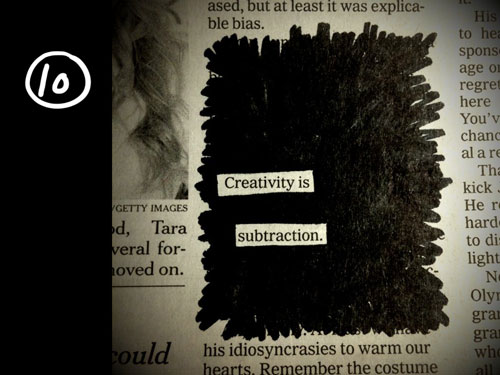

In this age if information overload and abundance, those who get ahead will be the folks who figure out what to leave out, so they can concentrate on what's important to them. Devoting yourself to something means shutting out other things. 

April 4, 2011

"Ten Things I Have Learned"

I came across this a few months ago, part of Milton Glaser's AIGA talk in London, November 2001. I find it equally fascinating and insightful. You can read the full list here.  

You can only work for people that you like.
This is a curious rule and it took me a long time to learn because in fact at the beginning of my practice I felt the opposite. Professionalism required that you didn't particularly like the people that you worked for or at least maintained an arms length relationship to them, which meant that I never had lunch with a client or saw them socially. Then some years ago I realised that the opposite was true. I discovered that all the work I had done that was meaningful and significant came out of an affectionate relationship with a client. And I am not talking about professionalism; I am talking about affection. I am talking about a client and you sharing some common ground. That in fact you view of life is someway congruent with the client, otherwise it is a bitter and hopeless struggle.

Some people are toxic avoid them.
This is a subtext of number one. There was in the sixties a man named Fritz Perls who was a gestalt therapist. Gestalt therapy derives from art history, it proposes you must understand the ‘whole’ before you can understand the details. What you have to look at is the entire culture, the entire family and community and so on. Perls proposed that in all relationships people could be either toxic or nourishing towards one another. It is not necessarily true that the same person will be toxic or nourishing in every relationship, but the combination of any two people in a relationship produces toxic or nourishing consequences. And the important thing that I can tell you is that there is a test to determine whether someone is toxic or nourishing in your relationship with them. Here is the test: You have spent some time with this person, either you have a drink or go for dinner or you go to a ball game. It doesn’t matter very much but at the end of that time you observe whether you are more energised or less energised. Whether you are tired or whether you are exhilarated. If you are more tired then you have been poisoned. If you have more energy you have been nourished. The test is almost infallible and I suggest that you use it for the rest of your life. 

How you live changes your brain.
The brain is the most responsive organ of the body. Actually it is the organ that is most susceptible to change and regeneration of all the organs in the body. I have a friend named Gerald Edelman who was a great scholar of brain studies and he says that the analogy of the brain to a computer is pathetic. The brain is actually more like an overgrown garden that is constantly growing and throwing off seeds, regenerating and so on. And he believes that the brain is susceptible, in a way that we are not fully conscious of, to almost every experience of our life and every encounter we have. I was fascinated by a story in a newspaper a few years ago about the search for perfect pitch. A group of scientists decided that they were going to find out why certain people have perfect pitch. You know certain people hear a note precisely and are able to replicate it at exactly the right pitch. Some people have relevant pitch; perfect pitch is rare even among musicians. The scientists discovered – I don’t know how - that among people with perfect pitch the brain was different. Certain lobes of the brain had undergone some change or deformation that was always present with those who had perfect pitch. This was interesting enough in itself. But then they discovered something even more fascinating. If you took a bunch of kids and taught them to play the violin at the age of 4 or 5 after a couple of years some of them developed perfect pitch, and in all of those cases their brain structure had changed. Well what could that mean for the rest of us? We tend to believe that the mind affects the body and the body affects the mind, although we do not generally believe that everything we do affects the brain. I am convinced that if someone was to yell at me from across the street my brain could be affected and my life might change. That is why your mother always said, ‘Don’t hang out with those bad kids.’ Mama was right. Thought changes our life and our behaviour. I also believe that drawing works in the same way. I am a great advocate of drawing, not in order to become an illustrator, but because I believe drawing changes the brain in the same way as the search to create the right note changes the brain of a violinist. Drawing also makes you attentive. It makes you pay attention to what you are looking at, which is not so easy.

Doubt is better than certainty.
Everyone always talks about confidence in believing what you do. I remember once going to a class in yoga where the teacher said that, spirituality speaking, if you believed that you had achieved enlightenment you have merely arrived at your limitation. I think that is also true in a practical sense. Deeply held beliefs of any kind prevent you from being open to experience, which is why I find all firmly held ideological positions questionable. It makes me nervous when someone believes too deeply or too much. I think that being sceptical and questioning all deeply held beliefs is essential. Of course we must know the difference between scepticism and cynicism because cynicism is as much a restriction of one’s openness to the world as passionate belief is. They are sort of twins. And then in a very real way, solving any problem is more important than being right. There is a significant sense of self-righteousness in both the art and design world. Perhaps it begins at school. Art school often begins with the Ayn Rand model of the single personality resisting the ideas of the surrounding culture. The theory of the avant garde is that as an individual you can transform the world, which is true up to a point. One of the signs of a damaged ego is absolute certainty. Schools encourage the idea of not compromising and defending your work at all costs. Well, the issue at work is usually all about the nature of compromise. You just have to know what to compromise. Blind pursuit of your own ends which excludes the possibility that others may be right does not allow for the fact that in design we are always dealing with a triad – the client, the audience and you. Ideally, making everyone win through acts of accommodation is desirable. But self-righteousness is often the enemy. Self-righteousness and narcissism generally come out of some sort of childhood trauma, which we do not have to go into. It is a consistently difficult thing in human affairs. Some years ago I read a most remarkable thing about love, that also applies to the nature of co-existing with others. It was a quotation from Iris Murdoch in her obituary. It read ‘ Love is the extremely difficult realisation that something other than oneself is real.’ Isn’t that fantastic! The best insight on the subject of love that one can imagine.

March 20, 2011

Sunrise Series

The last time I made a post like this, it was about my obsession with photographing sunsets, to which someone responded "what about sunrises?" At the time I wasn't getting up early enough to photograph, but now, with a full-time job and Daylight Saving Time kicking in last week, I am up before the sun and running for my camera at the first sign of color on the eastern horizon.


March 17, 2011

Groovin' in Groove Time


From 9 in the morning 'til about noon, and then 1-4 in the afternoon is known as "Groove Time" at work. Ideally it is a period of uninterrupted, focused work time. If anyone needs anything, we try to use email or iChat before going to that person's office. The "rules" of "Groove Time" are of course, more like guidelines, and are bent accordingly. And now to what this post is really about: the music I've been listening to while working. I'm getting tired of the 2,000+ songs in my iTunes library, so I've been listening to a lot of Pandora and some new music my coworker has shared with me, including a bunch of singer/songwriter stuff (right up my alley). Many of the artists I've heard of, but never bothered to buy any of their music, so it's nice to get it for free. The above playlist is a sampling of what I've been listening to for the past week.   

March 8, 2011

The World's Most Typical Person


For starters, I love National Geographic. The photography is incredible, the content always interesting, and facts fascinating, as are the ones in this video. In 2011 the global population is supposed to reach 7 billion and the magazine has taken part by producing a 7-part year-long series profiling the world's population. It starts here, with identifying the world's most typical person, which according to the facts, is supposed to change in the next 20 years. Amazing, is all I have to say, and beautifully designed.   

March 5, 2011

Why You


One of my recent musical discoveries is Joe Purdy, who has joined the growing list of singer/songwriters I have developed an increasing infatuation with. I am drawn to the soulful lyrics, strong melodies, and the use of acoustic guitars.  I had yet to purchase any of his music, but yesterday, after one of my coworkers mentioned in passing that Purdy is coming to perform here, we got into a lengthy discussion about music and I ended up going home with more Joe Purdy than I would ever be willing to buy at a single time, plus a few others. Some of the artists I had heard of, but most I hadn't. He is coming to Santa Fe the end of April; it'll be an hour-long drive both ways - on a night when I have to go to work the next day -  but totally worth it.

February 26, 2011

Matchbooks, Tin Cans, and Other Old Things


I am in the process of redoing a design project I first completed in college; throughout this first stage I've been looking for inspiration in a book about vintage matchbook covers and another on antique tin cans. I'm also looking for other things that have an aged appearance, such as the sheet music and the newspaper clipping above. Mostly what I'm drawing from these is not only the idea of something old, but something classic and timeless. Color explorations are going on as well, looking at the various shades of color coming from these artifacts and drawing connections between them. What makes these colors work together? How do they differ from those that are taken straight from the "digital age?" In truth, whites are not really white and blacks are hardly black. Many painters believe that using manufactured blacks muddy the paint and  produces color that is untrue to our perceptions. This belief can be applied to anything where color is used; blacks should be made by combining other colors, thus the hues of these mixed colors appear in the "black." After I scanned the sheet music and clipping I used the eye dropper to sample the "black" ink. In taking a closer look, none of the samples were 100% black. Each sample has a shade of purple, red, or blue depending on where I clicked and proves that our perception and understanding of color is largely skewed.